-
(Based on the Revised 1975 AKC Standard) - Which Is the Best Pointer?
- Pointer Fig 1 "sans markings" was photographed years ago having won the Sporting Group at an American show. German Shorthaired Pointer Fig 2 won the Group the next day. I use the photograph of Fig 1 in my all-breed type, structure, locomotion presentation to pose the question, "What breed does this Pointer remind you of?" Invariably the answer is a German Shorthaired Pointer.
-
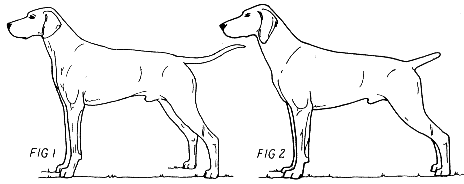
- Reduced to bare outlines without markings and compared at the same height i.e. 25-inch minimum for the male Pointer and 25-inch maximum for the male GSP, there is a similarity. Neither is ideal, but even so Fig 2 looks more like a GSP than Fig 1 looks like a Pointer. Study of Fig I will not help to formulate an image of ideal, in fact it serves best to warn of departures. From a type standpoint, you will see how this Pointer departs from typical as this article progresses.
-
-
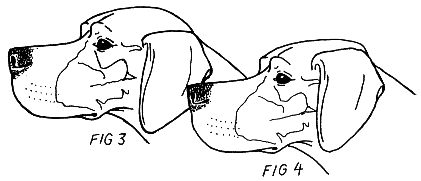 Which Head Is Correct?
 - There are two differences between Fig 3 and Fig 4 heads. The Standard errs in my opinion in asking for the ears to set on at eye level, and by neglecting to say anything about the necessity for a pronounced occiput (back of skull). I prefer Fig 4's higher ear set and possession of a pronounced occiput.
- The Head
- It is generally accepted that the head is the hallmark of the Pointer. It is both field functional and show distinctive. The Pointer's head enables it to excel in the field, where it must locate upland game by scent in heavy cover.
- As for appearance, the Pointer's head is required to have:
- · a skull of medium width;
- · a slight furrow between the eyes;
- · cleanly chiseled cheeks;
- · well-developed wide open nostrils;
- · jaws ending square;
- · eyes of ample size, rounded and intense, the eye color dark in contrast with the markings, the darker the better;
- · flews that are not pendulous.
-
 Two Head Types
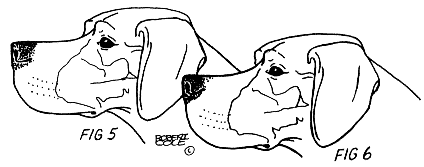
 - In the United States, there are two types of head, i.e. "the parallel planes" head and one with "a muzzle with the nasal bone so formed that the nose is slightly higher at the tip than at the stop".
- Fig 5 represents a "parallel-planes" head and Fig 6 represents a somewhat concave, slightly dished muzzle although the AKC Standard does not use the words concave or dished; in fact in the book The Pointer, A Graphic Discussion of the AKC Standard, 1981, the author John G. Laytham depicts the muzzle on his "Dished-Face" drawing as a straight line without dish, the muzzle just tipped up.
- Based on what I see at Canadian and American shows, Fig 6's slight dish is how I interpret the intent of the AKC Standard, if not the exact wording. However since the AKC Standard doesn't include the British words, "concave, slightly dished-faced appearance" I could be wrong. The next five drawings convey what I mean.
-
Five Muzzles -

- The slightly dished-faced muzzle on Head D produces quite a different appearance than does the parallel planes on Head A. The initial response by American artists to "nose slightly higher at the tip than at the stop" was to produce Head B wrong because it promoted a projecting chin. This eventually was corrected in Head C to conform to "jaws ending square". Slight dished-faced Head D was the next logical if not specified step. Taken too far, extreme dished-faced Head E represents too much of a good thing.
- Unofficial Ideal
-
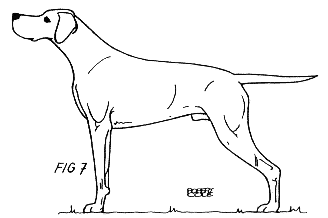 Before you assess the next two dog classes, each with three real-life Pointers, consider the merits of Fig 7. He doesn't exist in real life; he illustrates in simple outline the image in my mind's eye of Pointer ideal.
 - This unofficial representation of ideal serves to graphically fill in the blanks in the AKC Standard as well as illustrate that which is clear and concise beginning with the head. For example:
- The length of this Pointer's muzzle is half the length of the head, the midpoint being the inner corner of the eye. The ears are set on high, lie close to the head and are somewhat pointed at tips. The neck is long, dry, and slightly arched. The forechest is obvious. The withers are high, the long shoulder blades are well laid back and close together at their points together with a sloped upper arm of good length. The elbow is level or very slightly below brisket and is situated midpoint between withers and as in the ground making the foreleg equal in length to depth of body as in the Italian Standard. The foreleg has oval bone; the pasterns are thinner than forearm and slope slightly forward. The feet are oval, the toes are arched.
- The body is slightly longer than tall. The Italian Standard describes the Pointer as square measured from the point of shoulder (not the point of forechest) to the point of buttocks. Tuck up is apparent. Good hindquarter angulation is in balance with forequarter angulation. The tail is heavy at root, set on level with the croup's slight slope, tapers to a fine point, and is of no greater length than distance to hock.
- Dog A, Dog B, Dog C ?
-
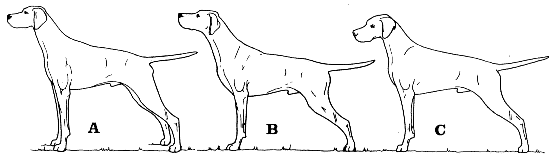
- You are invited to place in order of merit three American champions. Two of the three won BIS and if the third did not win a BIS he was honored on at least one occasion as a great Pointer of the past. I selected these three proven acceptable Pointers because they are so different from one another. Their markings have been removed to protect the innocent.
- These three particular Pointers provide an interesting study. None of their croups round off to the degree of my ideal. Stretched, none position with their rear pasterns vertical. Only two have the smooth transition of slightly arched neck into withers and topline. Two appear to have cat feet. One appears shorter bodied than the other two only because his less-well-angulated shoulder blade and upper arm have forced his body to raise above the elbow. And one has too much forechest and crouches in the rear.
-
Make your choices for 1st, 2nd, 3rd now. -
-
- First, Second, Third
- I gave first place to Dog C, aware that his feet are incorrectly more round than oval and that there is a little too much slope to the front pasterns. Second place went to lanky Dog A, and third place to Dog B who possesses compact power but lacks graceful curves and lissome appearance.
-
- Dog D, Dog E, Dog F?
-
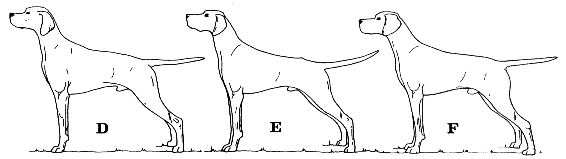
- All three Pointers in this class have won more than one American BIS. If there is such a thing as an American show Pointer as opposed to an English show Pointer which is different again from an Italian show Pointer, then surely it is represented in this class.
- All three have a "parallel-planes" head which could be a coincidence. Feature by feature, there are many similarities and few differences. At this level of excellence, there are not many faults but there are enough differences and faults that first, second and third place can be arrived at.
- Just as it is important that you appreciate Pointer virtues, it is equally important that you can recognize faults both in type and in structure. Beginning with Dog D, his muzzle could be longer, his shoulder blades could slightly have more slope and his topline could be improved. Dog E's brisket is a little above the elbow and his topline could be improved especially at beginning of the croup. The only obvious fault possessed by Dog F is that his ears are higher than "set-on-at-eye-level" ears which I personally do not consider a fault.
-
Make your choices for 1st, 2nd, 3rd now, then choose WD and RWD -
-
- First, Second, Third, Winners Dog, Reserve
- I gave first Place to Dog F, second to Dog E, and third to Dog D.
- Winners Dog went to Dog F, and Reserve to Dog C.
-
Copyright © WorldClassDogs Internet Inc. 1996 - 1999
We hope everyone has enjoyed our commitment to educating people about Pointers
by publishing useful information from others. Check our links page for more!
Back
to
Remington Pointers